


If there’s background music, how do I include it? When a character sings, how on Earth do you format that? What about formatting lyrics?
Great questions.
In general, it’s best to not indicate specific songs unless it’s absolutely integral to the story (i.e., you’re writing a movie about the Beatles, and there’s a scene in which they play “Help!”).
You’d have to own the rights to the song, or the song would have to be in the public domain (note: “Help!,” which is most certainly not in the public domain, would cost a pretty penny to license). If there’s music in the scene, you can refer to it generally and let the production team decide the details.
Background Music
If you want to set a general tone with music, it’s simpler than you think. Here’s what Dave Trottier says in The Screenwriter’s Bible, v. 7 (page 288).
If you must indicate music, do so in a general way.

Another way to indicate music generally is to describe the sound of it: The radio BLASTS. Keep in mind that since music is a SOUND, you can emphasize it by placing it in CAPS, although it is not necessary to do so.

A Character Sings
But what if you, as a writer, need to include to include a song and you have the rights? There are a ton of different ways you could do that. I’m going to examine several different ways from recently produced screenplays.
Here’s an example from Noah Baumbach’s Marriage Story.

Assuming that Noah has the rights to “Being Alive,” he, as a writer-director, he’s going to decide later what lyrics he’s going to include from the song.
Song Lyrics: Method 1
In the dialogue, write out the lyrics in a stanza-like way, so each line of the song has its own line of dialogue.
Here’s an example from Anthony McCarten’s Bohemian Rhapsody.
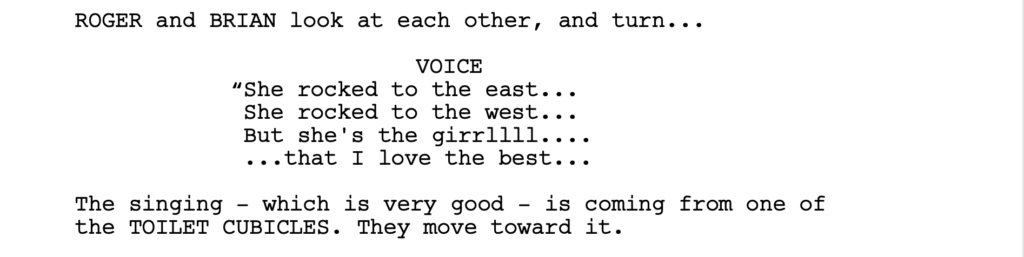
As an alternative, you could also eliminate the ellipses with slashes. Note how we don’t know that the voice is singing; the formatting gives us a clue. (I’m guessing the second quotation mark is left off because it intimates that it’s up to the director/producer to figure out when the end of the song occurs.”
Song Lyrics: Method 2
You could also capitalize the lyrics, have them run together (or not assign one line of lyric to a line of dialogue), and even add slashes. Here’s an example from Kay Cannon’s Pitch Perfect.

Note how, unlike in Method 1, there aren’t any quotations. And here, the “singing” comes before in the action line. This is a perfectly acceptable alternative.
Song Lyrics: Method 3
You could also italicize the lyrics, use quotations, and separate them out line-by-line. Here’s an example from Bradley Cooper, Will Fetters, and Eric Roth’s A Star is Born.

Here, there’s the parenthetical of “into mic; singing” which provides accurate direction.
The Bottom Line
Any of these variations work (and you could probably come up sub-variations of your own). The most important thing is that, in your own script, you’re clear, concise, and consistent.