


Last week, we covered the basics of how to cover texting.
This week, we’ll cover phone conversations, and there are several different ways you can do it.
For this post, I’m sharing an excerpt from Dave Trottier’s The Screenwriter’s Bible (pages 301-303), an excellent resource. (Please note that the below italicized text is from Mr. Trottier’s book, but I’ve added “Method 1, 2, 3, etc.” headings to break it up).
There are essentially four methods for handling phone conversations.
Method 1
Use this method when the audience does not see or hear the other party. This is handled like any other speech.

Notice that I did not use the word “beat” to indicate a pause, although I could have.
Method 2
The second situation is when the audience hears the other person, but does not see him or her. In that case, the dialogue of the person not seen is voiced-over.

Method 3A
The third situation is when the audience both hears and sees the two parties. In such cases, use the intercut. You can handle it simply, as with the following example:

That would be followed by dialogue written like any other conversation. Please note that when you don’t establish the locations prior to the intercut, you must in the intercut heading, as demonstrated above.
Method 3B
Another method of using the intercut is to establish the two locations first. That way you don’t have to indicate locations in the intercut heading. That is what I did on the sample script and in the example below.
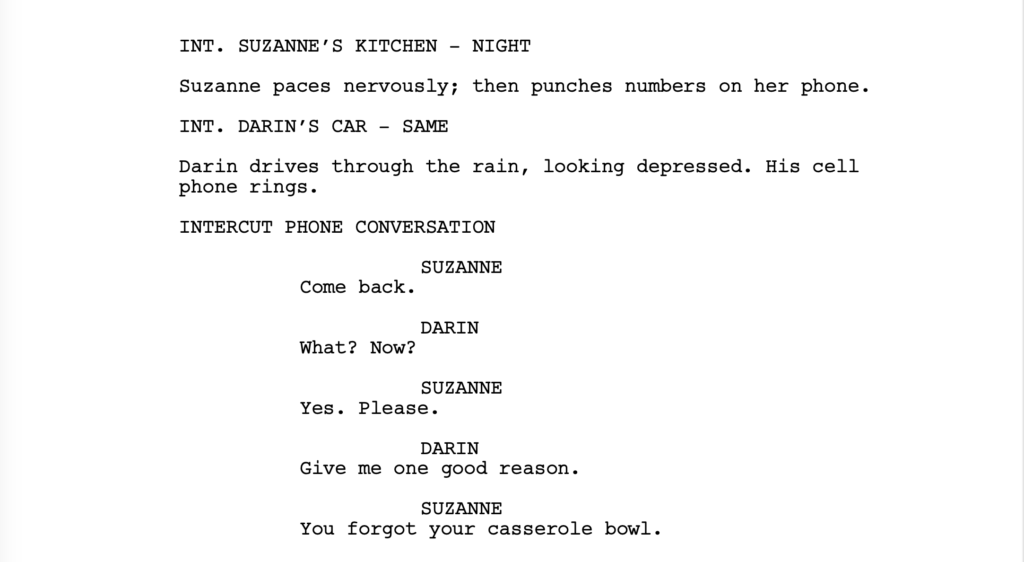
The INTERCUT device gives the director complete freedom as to when the intercut between speakers (he has complete freedom anyway, so why not be gracious?), plus it’s easy to read.
Method 4
Use master scene headings with each change of speaker. This can become laborious and interrupt the story flow. On the other hand, it may improve the scene in a particular situation and give you more dramatic control over which character the camera is on at any point in the conversation.
Again, that was an excerpt from Dave Trottier’s The Screenwriter’s Bible. I highly recommend you pick a copy.
Case Study: American Fiction by Cord Jefferson
As I was reading American Fiction in preparation for an upcoming post, I came across an example of a telephone conversation.
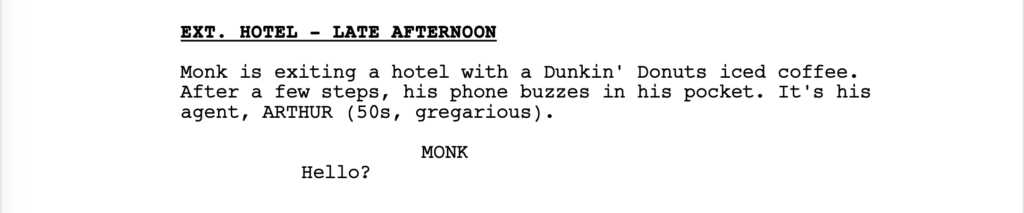
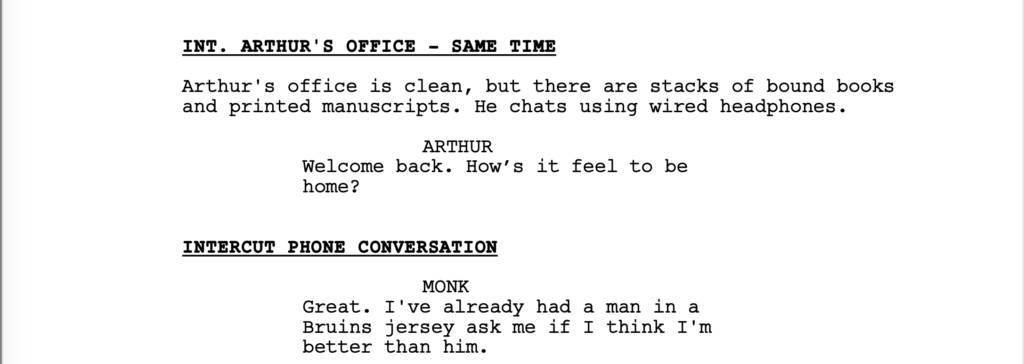
Here, writer Cord Jefferson uses a formatting closest to Method 3B in that he’s introducing the first location and first character (Monk at the Hotel), the second location and second character (Arthur at Arthur’s Office), and then “Intercut Phone Conversation.”
I wanted to highlight the minor point that underlining and bold-ing (emboldening?) the sluglines and subslugs. That’s perfectly okay because that’s his non-distracting stylistic choice, and it’s consistent throughout the script.
Ergo, there’s not one absolute way to do this.
Just be clear, concise, and consistent.