

As this is the first in this series addressing formatting issues, I thought it would be appropriate to address how to introduce a character for the first time. Here are some do’s and don’ts.
Do’s:
- Put that character name in all caps
- Give an age or approximate age range
- Give a 1-2 sentence description about the character’s appearance/vibe/demeanor so that the reader gets it
Don’ts:
- Keep capitalizing that name after its first introduction
- Go overboard with the description/make it too specific
- Mention a name actor whom you’d like to play the role; sure, it’s great to write with an actor in mind, but you don’t want to narrow the focus too much because the reader may have someone different in mind; no need to psychologically poison that well.
But if we’re not supposed to name actors, how does Barbie get away with it?
I’ve included an example of the script below.
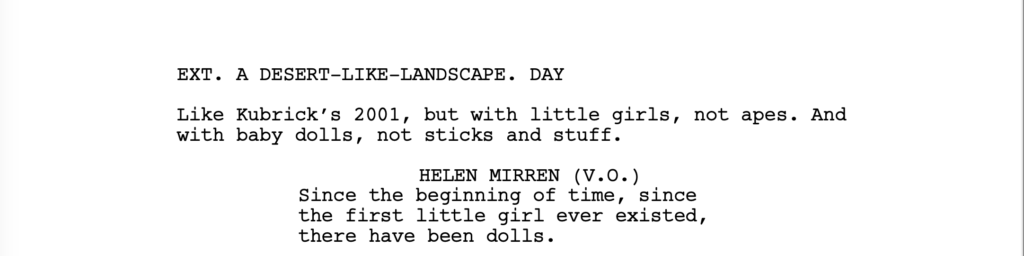
If you continue reading the script, you’ll see the characters names are “Barbie Margot” or “Ken Ryan Gosling.” Although William Goldman once said that “Nobody knows anything” in Hollywood, I’m guessing the filmmakers did this because 1) it’s a shooting script, and 2) even if this isn’t a normal practice for a shooting script, because almost everyone is named Ken or Barbie, they had to do something to differentiate one Ken or Barbie from another; adding Helen Mirren goes with the theme.
Let’s check out another example:
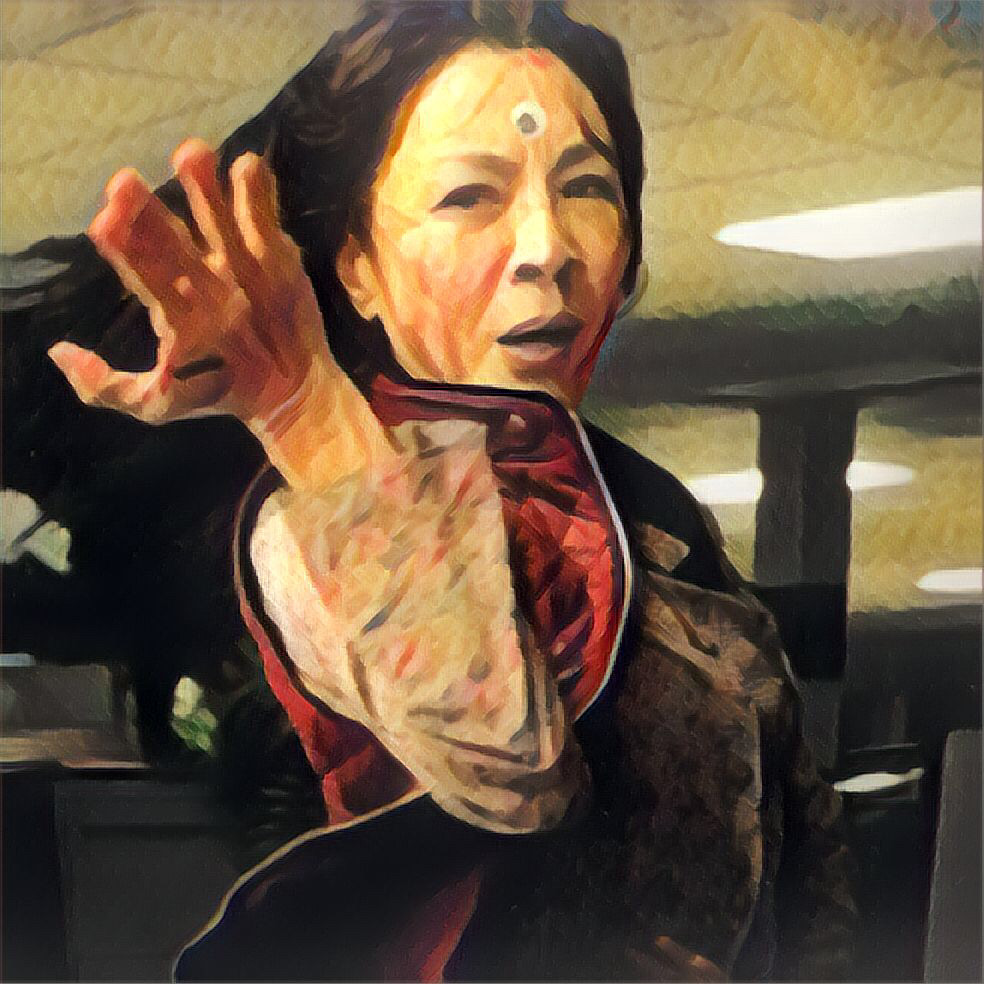
Here is a snippet from Everything Everywhere All At Once.
EVELYN WANG bursts into the room, a 55 year old Chinese woman in an over sized t-shirt, streaks of gray in her hair and thin outdated designer glasses.
See how succinct that is? From this very description, we know her age, ethnicity, clothing style (or perhaps lack thereof); her “burst(ing) into the room” also gives us a sense that this character is vibrant and in the middle of something. Continuing with the description…
The tiny dining room is overpopulated with workout equipment, self-help and inspirational business books, an old TV playing a Chinese soap opera, a live security feed for the laundromat downstairs, a rice cooker spewing steam, & a microwave with one minute to go. It is a still life of chaos.
What’s interesting is that more exposition about her character is given through environment: we can ascertain that this person is probably of lower socio-economic status; seems mentally scattered; speaks her native tongue; perhaps likes working out (or the idea of it); owns the laundromat below; eats for convenience/efficiency.
While describing a character for the first time may seem daunting, it doesn’t have to be.