


Technically, nothing.
Except they’re decorative AF and you lose narrative momentum.
Let’s explore!
What’s an Adverb?
As a recap, an adverb modifies (or describes) a verb, an adjective, or another adverb; it answers the question of “how.”
In the case of an adverb modifying a verb, “he ran well” – here, the verb is “ran” and the adverb is “well.” (So, how did he run? He ran well.)
In the case of an adverb modifying an adverb, “he ran really well” – the first adverb is “really” and the second adverb is “well.” (How well did he run? He ran really well.)
In the case of an adverb modifying an adjective, “she is really pretty” – the adverb is “really” and the adjective is “pretty.” (How pretty is she? “She is really pretty.”)
So, What’s Wrong with Adverbs?
“An adverb is like a doily,” a screenwriting teacher once told me. I never forgot it.
In other words, it’s decorative in that excessively cutesy kind of way.
What are the Alternatives?
Stronger verbs. Let’s look at an example.
Let’s say we wanted to replace “He ran well.”
A simple search on thesaurus.com for “run” yields this:
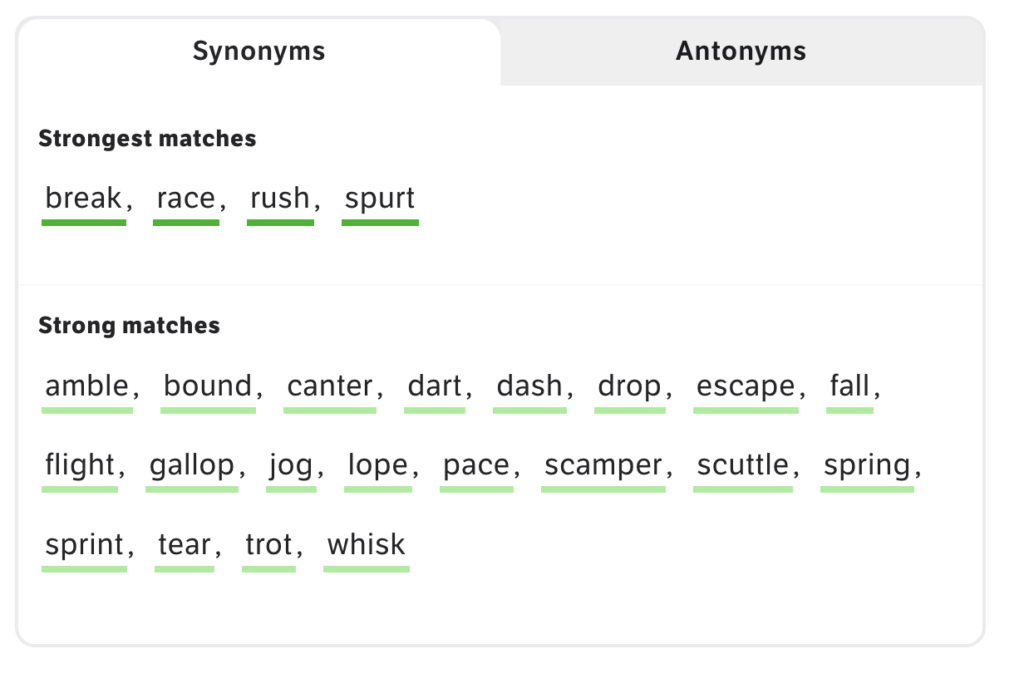
Given the context, what could you replace “run well” with? “He bounds”? “He scampers?” “He tears?”
See how all of these add a bit more flavor?
What are Participles?
Participles (both present and past) are verbals; they look like verbs but do not act like verbs. Instead, they’re acting as adjectives.
For instance, a present participle for this case is “She is watching.”
Nothing is technically wrong with this, but see how “she watches” may be stronger? It adds a little more narrative oomph.
A past participle is a little more forgivable. For instance, “the baked bread” indicates that “baked” has been done. Here, the verb is acting like an adjective (how else could you describe this in this way?).
Where past participles may be a bigger issue is if they’re used in a passive construction.
For instance, “The vase had been broken by me.”
A better way to say this (especially in action lines is “I broke the vase”). It makes for a cleaner read.
Make sense?
(And I hate doilies).