Skip to content
Modern Screenplay Logo Modern Screenplay

The Art & Craft of Great Screenwriting

Modern Screenplay Logo
Modern Screenplay

The Art & Craft of Great Screenwriting

Q. When to use the em dash versus ellipsis?

Charlotte, March 1, 2024April 12, 2024

Okay, so now we’re getting granular AF.

Luckily, the difference between the two is super easy. 

What’s an em dash and when can it be used?

The double dash (–) is also called the em dash (as opposed to an en dash, which is one line). You can use them either in dialogue or in action lines; in dialogue, it’s best to use it when a speaker is interrupted.

Let’s look at Nyad

Let’s look at a quick example from Nyad. Here, Bonnie Stoll (Jodie Foster) interrupts Diana Nyad (Annette Bening).
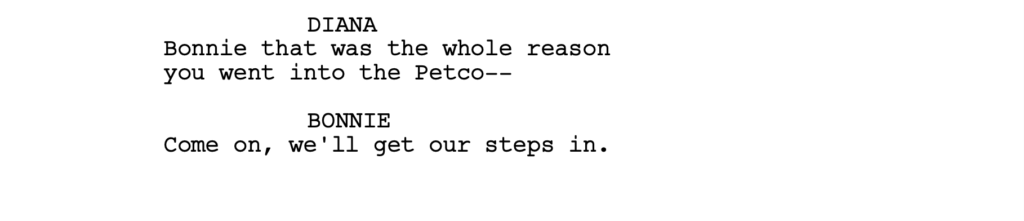
As a matter of style, some may say that Bonnie may want to have two dashes before “Come.” That’s fine, but to me, it makes the dialogue look as though Bonnie is continuing Diana’s thought (as opposed to interrupting it). Again, both versions are fine.

What about the ellipsis?

The ellipsis, which consists of three dots (…), is used when the speaker trails off, seems lost in thought, or slows his cadence when speaking.

Let’s look at example from Oppenheimer. 
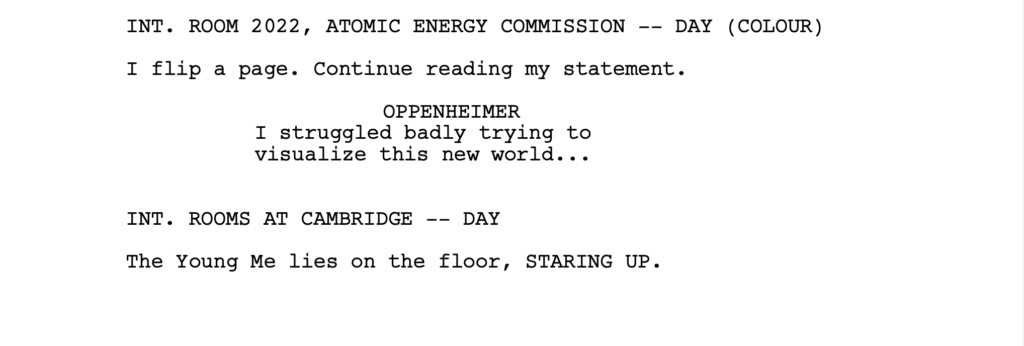
Here, Oppenheimer (Cillian Murphy) starts a thought in the present and continues it in narration through voiceover in the past.

Em dashes and ellipses can also exist in action lines.

If you check out last week’s montage article, you can see that em dashes are somewhat crucial to montage formatting. Here’s a quick sample:
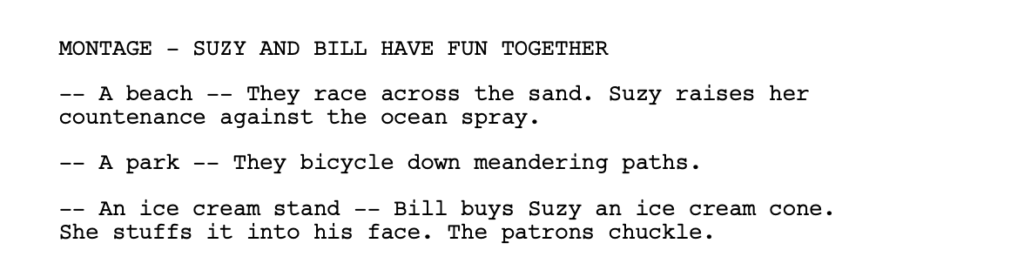
Note how here the em-dash separates out the location at the beginning of the sentence.

Here’s another example from Oppenheimer.
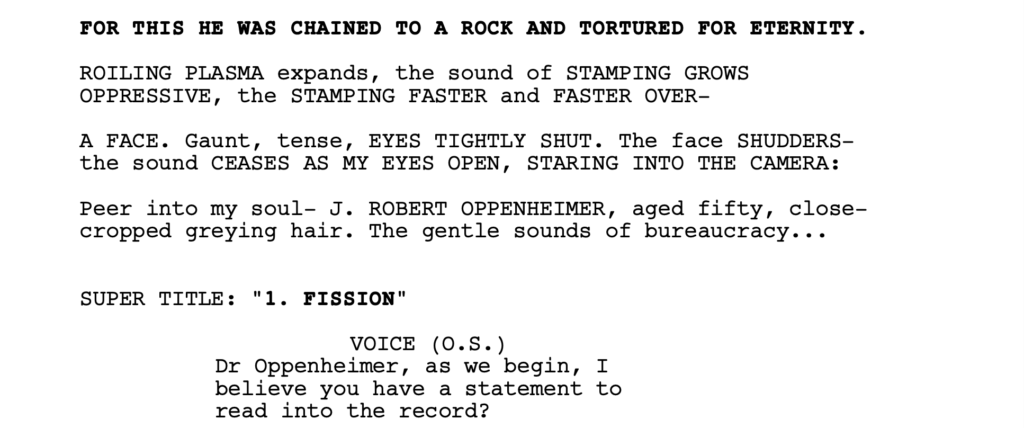
Note how the ellipses help here poetically describe Oppenheimer’s world with “the gentle sounds of bureaucracy.”

Can you ever use the en-dash?

Of course! En-dashes (or one dash) are typically used in the slug lines of movies (if em dashes aren’t). (If you look at the Oppenheimer example directly above, you’ll see one after “soul”).

Except for sluglines, I typically avoid them. As for em-dashes versus ellipses, neither is better than the other; they tend to have different stylistic intentions.

Whatever you do, just be clear, concise, and consistent…

Formatting Fridays

Post navigation

Previous post
Next post

Related Posts

Formatting Fridays

What are the Do’s and Don’ts of Parentheticals?

May 10, 2024May 11, 2024

As you may know, a parenthetical (also known as a “wryly”) is the text that exists right below a character’s name (in, yes, a parenthetical). Since it’s also called an “actor’s direction” or a “parenthetical direction,” it exists to give direction. These parentheticals often convey useful information about subtext or…

Read More
Formatting Fridays

Q. How to Format Phone Conversations?

February 2, 2024February 21, 2024

Last week, we covered the basics of how to cover texting.  This week, we’ll cover phone conversations, and there are several different ways you can do it.  For this post, I’m sharing an excerpt from Dave Trottier’s The Screenwriter’s Bible (pages 301-303), an excellent resource. (Please note that the below…

Read More
Formatting Fridays

Q. What are the Do’s and Don’ts of a Title Page?

April 26, 2024May 24, 2024

Because I spent so much time this week on Jojo Rabbit, I’m going to keep today’s Formatting Friday post short and sweet.  A screenplay’s title page exists to, well, give the title of a script and attach your name. (For all of the do’s and don’ts below, we’re going to…

Read More

About Me

Charlotte Winters

Hi, I’m Charlotte Winters. As an award-winning screenwriter with an MFA from UCLA who associate produced a show on behalf of The History Channel, lectured at UCLA, and freelanced at WB and FX, I am a lifelong student of the screenplay. I founded this blog because I love reading and analyzing great movies.

Search this Site

      ©2026 Modern Screenplay | WordPress Theme by SuperbThemes
