Skip to content
Modern Screenplay Logo Modern Screenplay

The Art & Craft of Great Screenwriting

Modern Screenplay Logo
Modern Screenplay

The Art & Craft of Great Screenwriting

David Hemington The Holdovers

Q. How Much Scene Description Should I Include?

Charlotte, January 19, 2024January 25, 2024

Describing a scene doesn’t need to be hard. 

All you have to do is to put enough to set the scene and highlight what is integral because…

White space is key. 

Not only does white space on the page give the reader’s eye space to rest, but it also allows space for fellow creatives to envision that world as it pertains to their expertise. This is where actors may write out blocking instructions from the director; it may be where the art department makes notes about various props, etc. 

Do not underestimate the power of white space. 

This is where the magic happens. 

Let’s look at an example

Here is an example from David Hemingson’s The Holdovers:
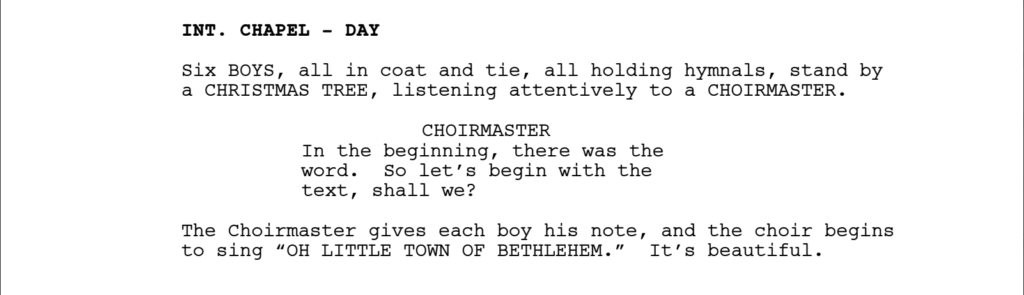
The cool thing about “December 18, 1970” and “chapel” is that it leaves enough room for production to choose a church pre-dating that era (i.e., one that was built in 1870, 1920, or even 1969), but it constrains the location/architectural choice to not existing past a certain point. 

It also goes without saying that the boys and choirmaster are going to be wearing clothes from that era. We don’t know why they’re wearing suit and tie, but we learn later that it’s a rehearsal at a New England prep school. (The date also clues us in; were it the actual concert, then it would probably be December 24 or December 25). Most likely, they’re obeying the dress code. 

The only real props that are mentioned are the hymnals and the tree. These help the viewer/reader envision what’s going on, but they’re not devastatingly important to the plot (except that the townies later take the tree, but that’s a small detail).

What I like about this scene is that it gives the minimum. 

Ample white space exists for the viewer to draw in the details.

Formatting Fridays

Post navigation

Previous post
Next post

Related Posts

Formatting Fridays

What are the 10 Commandments (of Screenplay Formatting)?

June 7, 2024June 8, 2024

In the beginning, there was The Screenwriter’s Bible by Dave Trottier. And it was good. And he wrote the 10 Commandments on page 250 of the Seventh Edition. And it was good. And I’m writing them out here to help you. Because I’m good. (And here they are). The 10…

Read More
Formatting Fridays

Q. How to Format Music in a Screenplay?

February 9, 2024April 12, 2024

If there’s background music, how do I include it? When a character sings, how on Earth do you format that? What about formatting lyrics? Great questions. In general, it’s best to not indicate specific songs unless it’s absolutely integral to the story (i.e., you’re writing a movie about the Beatles,…

Read More
Formatting Fridays

Q. Taglines, Loglines, and Sluglines: What’s the Difference?

February 16, 2024April 12, 2024

This one is going to be super quick because, while the terminology can be confusing, the differences among these the three are pretty clear.  Loglines Loglines are simply a 1-2 sentence summary that encapsulates the set-up of the movie and makes the script reader (usually a member of the industry)…

Read More

About Me

Charlotte Winters

Hi, I’m Charlotte Winters. As an award-winning screenwriter with an MFA from UCLA who associate produced a show on behalf of The History Channel, lectured at UCLA, and freelanced at WB and FX, I am a lifelong student of the screenplay. I founded this blog because I love reading and analyzing great movies.

Search this Site

      ©2026 Modern Screenplay | WordPress Theme by SuperbThemes